Skip to content

Blog to video

Paste a post, get a narrated video.

example.com/blog/how-to-see-the-northern-lights

What the northern lights are, and how to see them

You're out in the snow at midnight and the sky turns green. It looks like magic, but it has a cause, and the cause tells you where to stand and when to look. Here is what the northern lights are, and how to give yourself the best chance of seeing them. Every aurora starts on the sun, 150 million kilometres away. A solar storm throws a cloud of charged particles into space. The biggest clouds reach Earth one to three days later.
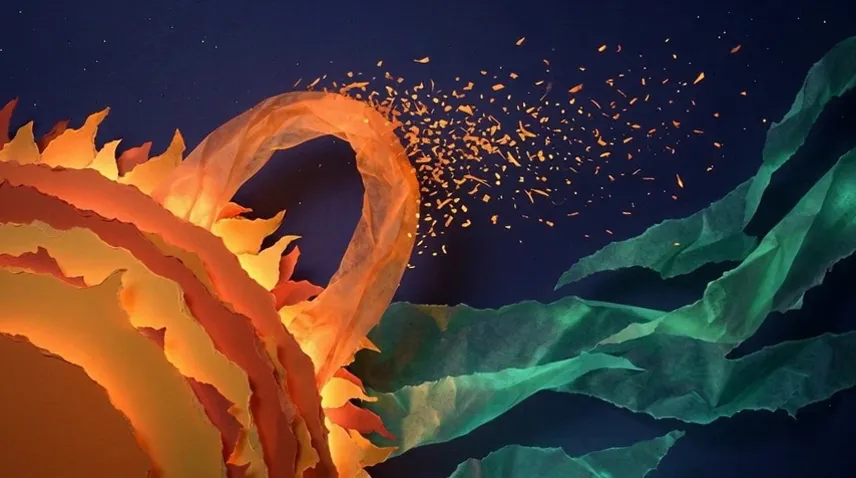
Scene 1 of 6 · from “It starts on the sun”

Storybook reads your post, writes a script from it scene by scene, animates every scene in one art style and narrates it. You don't film or record anything.

Turn a post into a video

Plans from $19 a month. 10 seconds to 5 minutes, widescreen or vertical, in 73 languages.

A sample post, turned into a video.Each part, and the scene it became.

We wrote this 301-word post about the northern lights as a sample and turned it into a one-minute video in the Cut Paper style, read by Victoria. Each part of the post sits beside the scene it became, with its spoken line word for word and its voice take.

example.com/blog/how-to-see-the-northern-lightsFor a first aurora trip.

What the northern lights are, and how to see them

  1. You're out in the snow at midnight and the sky turns green. It looks like magic, but it has a cause, and the cause tells you where to stand and when to look. Here is what the northern lights are, and how to give yourself the best chance of seeing them.

    It starts on the sun

    Every aurora starts on the sun, 150 million kilometres away. A solar storm throws a cloud of charged particles into space. The biggest clouds reach Earth one to three days later.
    A paper sun flings a cloud of glowing paper flecks across a dark paper sky, straight at the camera

    Scene 1 · 0:00

    Every aurora starts on the sun, 150 million kilometres away. A solar storm throws a cloud of charged particles into space.

  2. Earth's magnetic field steers it

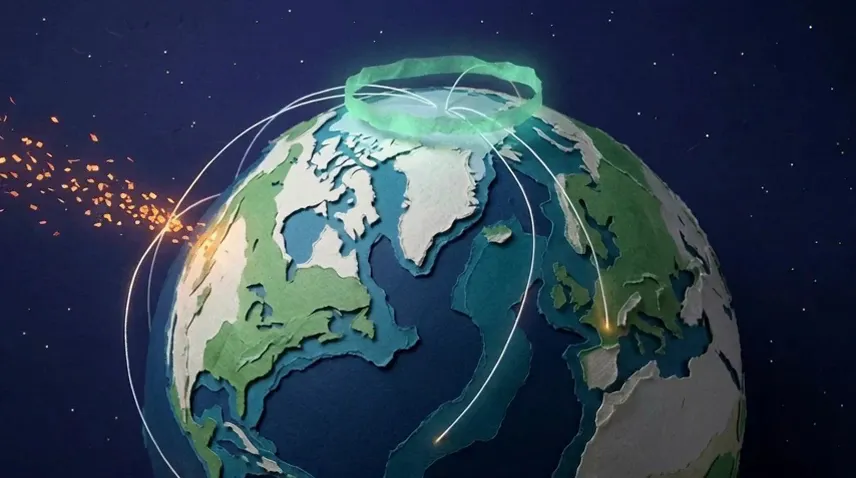
    Earth's magnetic field turns most of the cloud away. Some particles slide along the field lines toward the poles, where the lines dip down into the air. That is why auroras form in a ring around each pole, called the auroral oval.

    Glowing flecks slide along white field lines over a paper Earth and light a green ring around the North Pole

    Scene 2 · 0:10

    Earth's magnetic field turns most of the cloud away. Some particles slide along the field lines toward the poles.

  3. The air lights up

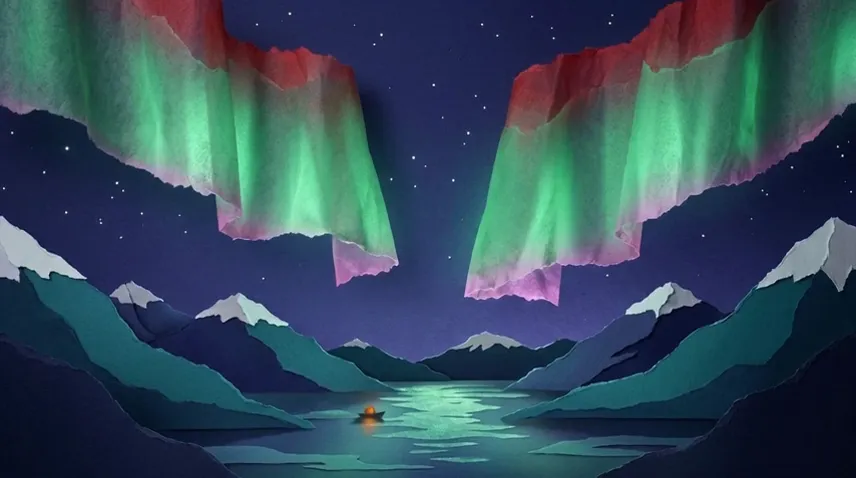
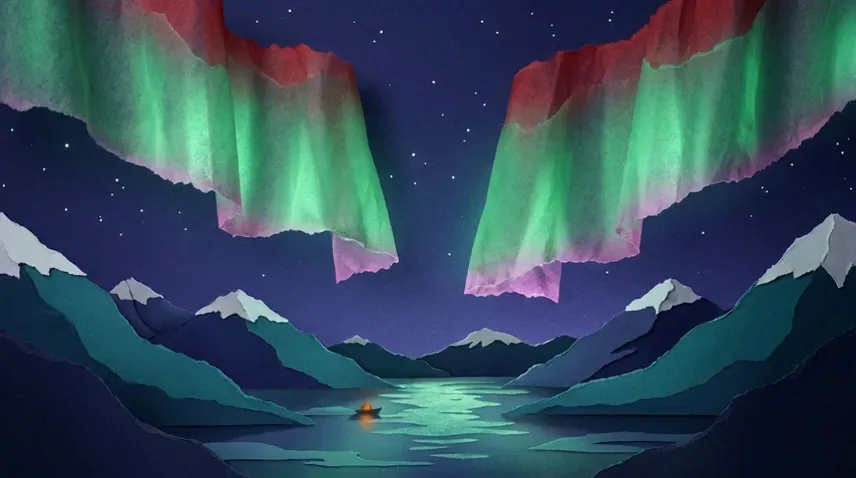
    About 100 kilometres up, the particles hit the thin air and make it glow. Oxygen glows green. Higher up, it glows red. Nitrogen adds the pink and violet along the lower edges, the way a neon tube glows when current runs through it.

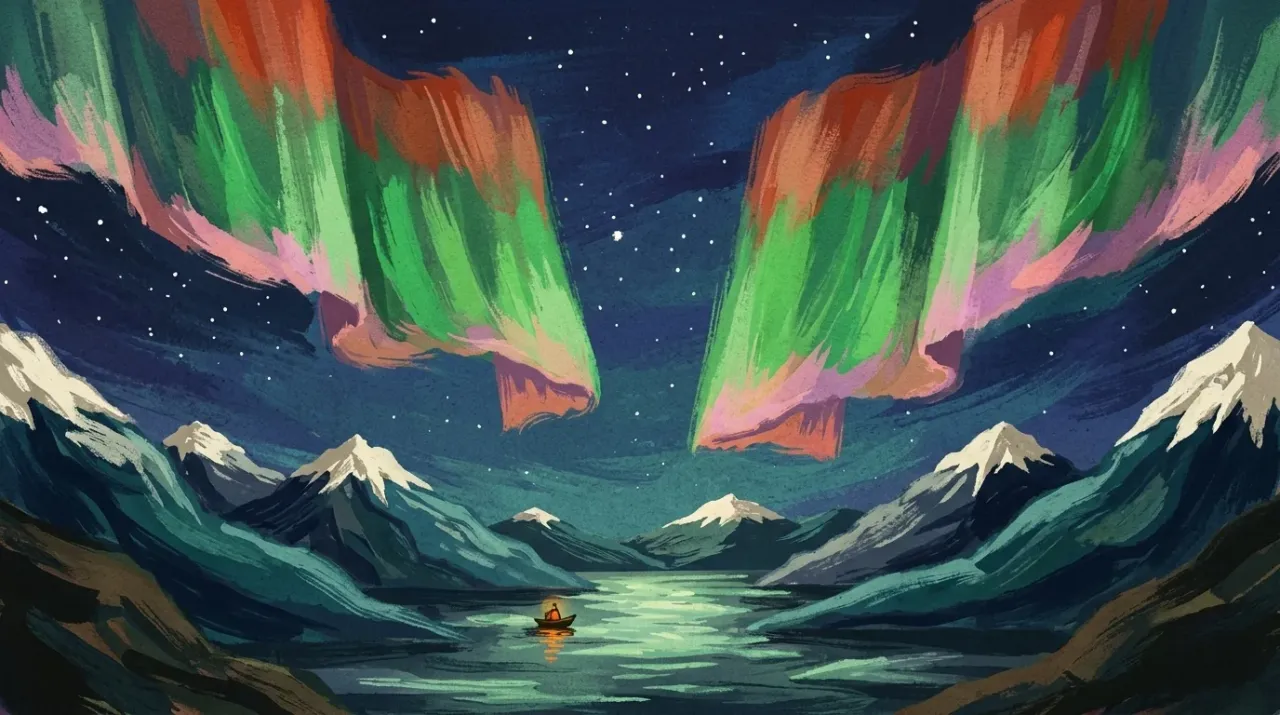
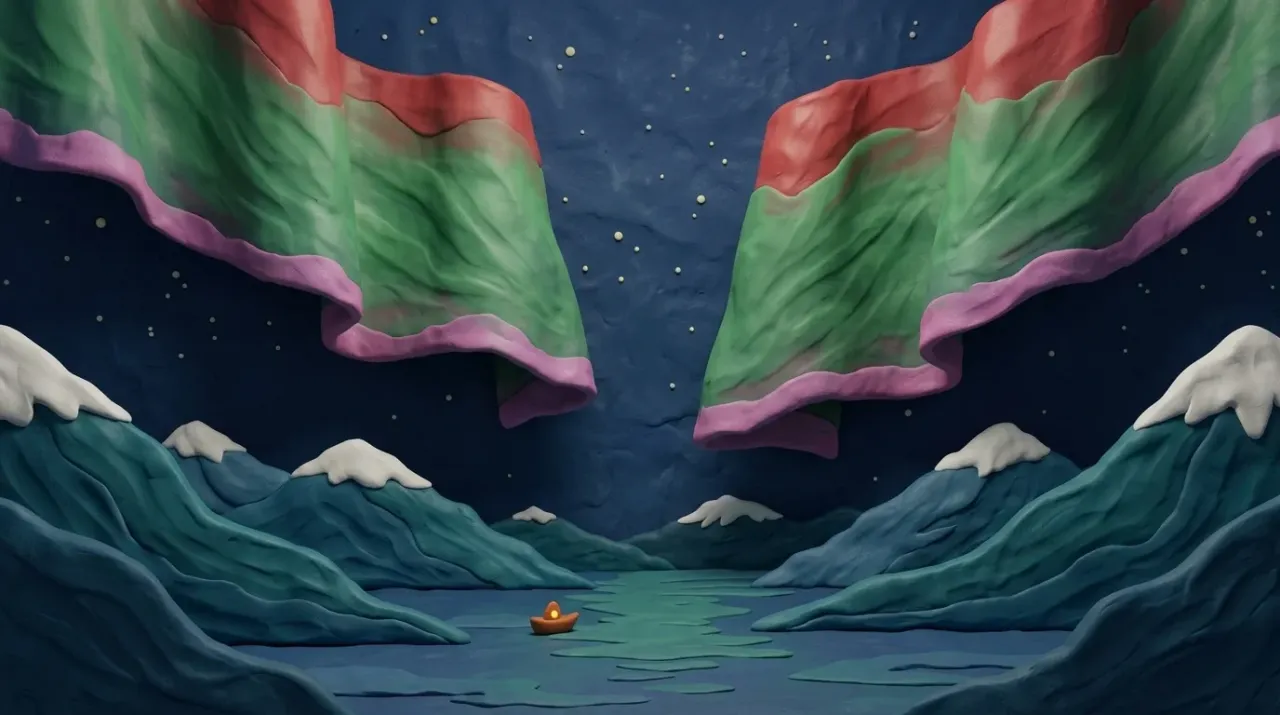
    Green tissue-paper curtains of the northern lights ripple over a paper fjord with a small boat

    Scene 3 · 0:20

    About 100 kilometres up, the particles hit the thin air and make it glow. Oxygen glows green. Higher up, it glows red.

  4. Go north, then go dark

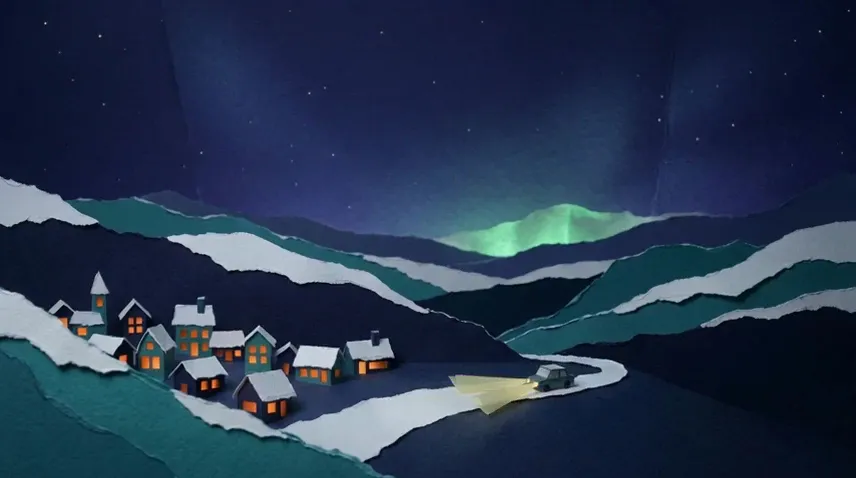
    Get under the oval: northern Norway, Finland, Iceland, Canada or Alaska, between September and March when the nights are long. Then drive at least half an hour from town. Street light washes out all but the strongest displays.

    A paper car drives out of a snowy town into a dark valley and switches off its lights as a green glow rises

    Scene 4 · 0:30

    Get under the oval: northern Norway, Finland, Iceland, Canada or Alaska. Then drive at least half an hour from town.

  5. Watch the clouds, not only the forecast

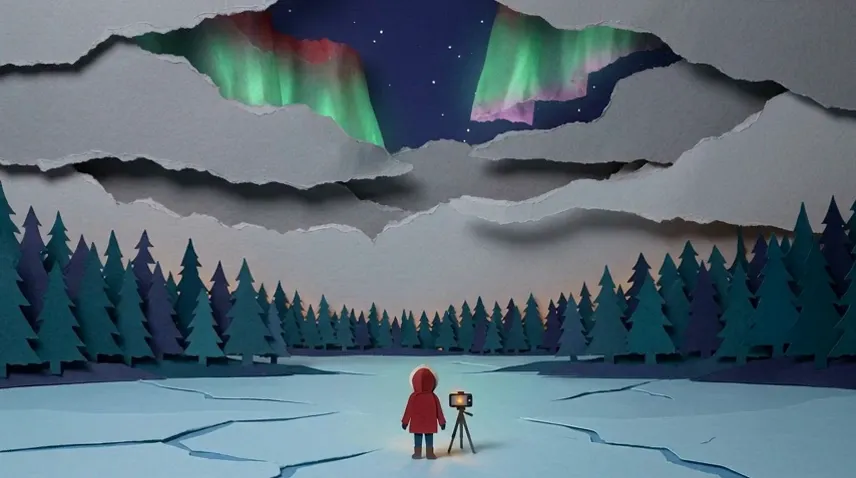
    The aurora forecast tells you how active the sky is, but cloud decides whether you see any of it. Check the cloud map, dress for minus twenty, and wait. The best displays often come between 10 pm and 2 am, and they come in waves, so give it a few hours.

    A person in a red parka waits on a frozen lake beside a phone on a tripod as the clouds part on the aurora

    Scene 5 · 0:40

    Check the cloud map, dress for minus twenty, and wait. The best displays often come between 10 pm and 2 am.

  6. Take the photo, then look up

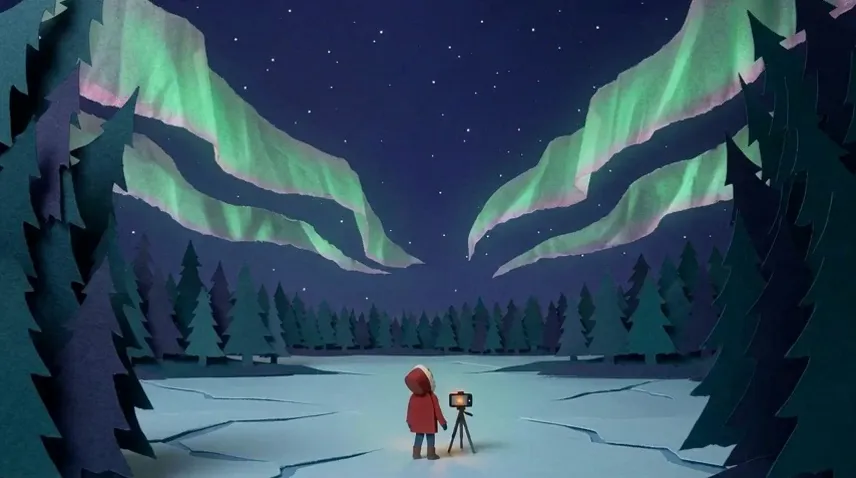
    Your phone's night mode catches colour your eyes miss, so prop it on something steady. Take your shots, then put the phone away and look up. When the lights pour down from one point, that is the corona: you are standing right under the storm.

    The aurora's green ribbons sweep together into one burst of rays straight overhead

    Scene 6 · 0:50

    Take your shots, then put the phone away and look up. When the lights pour down from one point, that is the corona.

Shorter keeps the points.Longer keeps the details.

Both scripts come from the same post. The 30-second cut still goes from the sun to the sky. Only the one-minute cut has room for the 100 kilometres, the five countries and the hours to watch. Pick any length from 10 seconds to 5 minutes.

30 seconds3 scenes

  1. 1

    Every aurora starts with a storm on the sun. Earth's magnetic field steers its particles toward the poles.

  2. 2

    There they hit the thin air and make it glow: green from oxygen, red higher up.

  3. 3

    Go north, get away from town, check the cloud map and wait. Then put the phone away and look up.

1 minute6 scenes

What the one-minute cut adds

Scene 1
150 million kilometres away
Scene 3
About 100 kilometres up
Scene 4
Norway, Finland, Iceland, Canada or Alaska · half an hour
Scene 5
minus twenty · between 10 pm and 2 am
Scene 6
the corona

Its full script runs beside the post above.

Match the look of your blog.One scene, four of 15 styles.

The style holds for every scene in the video, so a post comes out looking like one piece. Cut Paper is the look the scenes above use.

How to turn a blog post into a video.Paste, steer, pick, check.

  1. Copy the post's link

    Use the public URL. Storybook reads the page in full, so it has to open without a login or a paywall. A series can go in one video: paste up to three links.

  2. Add one line on the angle

    Write it after the link, such as who the video is for or which part to lead with. It frames the post. It doesn't add new material.

  3. Pick the length, shape and look

    10 seconds to 5 minutes. 16:9 for YouTube and the post itself, 9:16 for Shorts, Reels and TikTok. One of 15 styles, a narrator, a language, and switches for captions and music.

  4. Watch it

    You get one finished video with the scenes, the voice, the captions and the music in place. Compare names, numbers and quotes with your post.

Simple pricing that scales with you.

Pick the plan for how much you post. Every model on every plan. Unused credits roll over. Cancel anytime.

Creator

$19/month

Billed monthly

For solo creators posting every week

500 credits every month

  • Up to 250 AI images
  • Up to 18 videos
  • Up to 1.5 hours of AI voiceover
  • Roll over up to 1,000 credits

Pro

Most popular
$49/month

Billed monthly

For creators posting daily across channels

1,300 credits every month

  • Up to 650 AI images
  • Up to 48 videos
  • Up to 4 hours of AI voiceover
  • Roll over up to 2,600 credits

Studio

$99/month

Billed monthly

For brands and production teams

2,700 credits every month

  • Up to 1,350 AI images
  • Up to 100 videos
  • Up to 9 hours of AI voiceover
  • Roll over up to 5,400 credits

Scale

$199/month

Billed monthly

For agencies running always-on content

5,500 credits every month

  • Up to 2,750 AI images
  • Up to 203 videos
  • Up to 18 hours of AI voiceover
  • Roll over up to 11,000 credits
Every plan includesEvery model, 90+ and countingReusable AI personasSceneform Studio editorCommercial usage rights

Want checkout, comparison tables, or a custom volume? See the full pricing page

On the $19 plan, a one-minute video costs about $12 at 720p and $17 at 1080p.

Before you paste a linkCommon questions

Green tissue-paper curtains of the northern lights ripple over a paper fjord, from the one-minute video

You already wrote it.Now let people watch it.

Turn a post into a video

Plans from $19 a month.